Why I Practice
I came to yoga through strength sports. Years of Olympic Weightlifting and Highland Games left me with the accumulated aches and limitations that eventually sent me looking for a practice that could help put things back together.
What I found was Ashtanga Yoga–not simply a system of postures, but a practical discipline that connects body, breath, mind, and the study of yoga philosophy. For me, that also means learning to adapt the practice to the person rather than treating an idealized form as the goal.
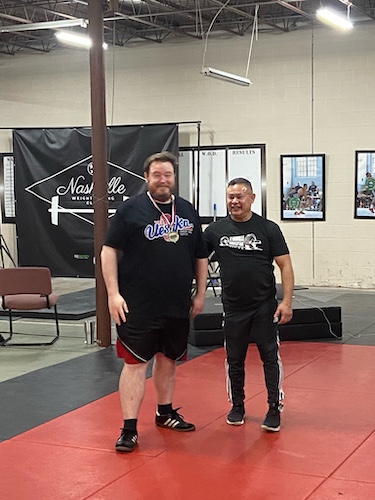 (Receiving a medal in the Tennessee State Weightlifting Championships from 1992 Olympian Osman Manzanares.)
My Teachers
- Derek Hall, Nashville. Local hands-on practice, observation, adjustment, and continuity.
- Greg Tebb, NYC. Asana development, adaptation, yoga therapy, and philosophy.
- Joey Paz, Northern California. Pranayama, mudra, bandha, vedic chanting and the broader limbs of yoga.
Yoga-Friends & Guides
- Andrew Eppler, Oklahoma. I first learned pranayama and Sankhya philosophy from Andrew.
- David Williams, Maui. A foundational influence on my understanding of Ashtanga and its history.
- Manju Jois, Encinitas. Direct connection through Greg to the Jois family tradition, vedic chanting, and yoga as a therapy.
- BNS Iyengar, Mysore India. Direct connection through Joey and Andrew to the original generation of Ashtanga teaching.
- Dr. MA Jayashree, Mysore India & Atlanta. Direct connection to traditional vedic chanting.
What I Believe
I believe yoga is learned in relationship–with teachers, with fellow practitioners, and with the tradition itself. I want to learn broadly without losing sight of where the practice comes from. For me, Ashtanga is a living tradition: rooted in a particular cultural and philosophical context, while still capable of being practiced thoughtfully by people living very different lives today.
I don’t approach yoga as a career or a business. It is a personal practice and a way of life for me. When someone in my community asks to practice together, I’m happy to share what I have learned, while continuing to regard myself first and foremost as a student.
“It is my belief, which I hope to convey to you, that in your practice of this moving meditation, what is important is what is invisible to the observer, what is within each of you.” —David Williams